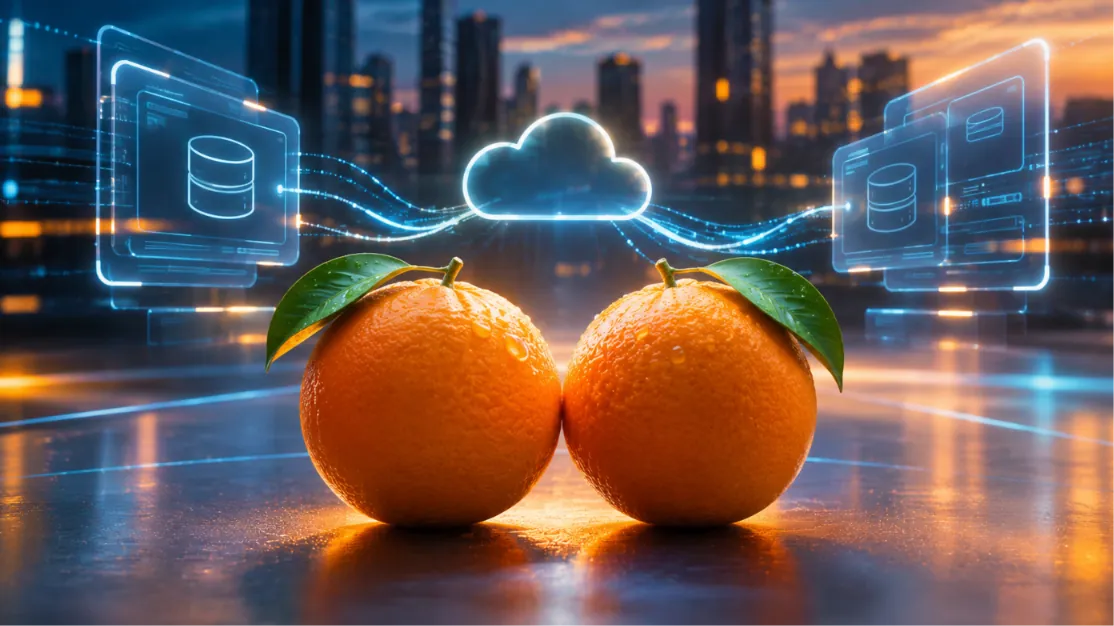
Good data analysis compares oranges to oranges. When every system, every vendor, and every project describes data in its own way, that comparison stops being possible. The ability of different systems to exchange information and understand each other is called interoperability, and it determines how much value a piece of data delivers outside the system that generated it.
Data that stays locked away
Data analysis in sanitation involves too many factors, such as where the water meter is installed and how worn it is, to depend on a single statistical model. For now, the most consistent path is a hybrid model that combines the data, knowledge of the territory, and what has been learned in field work, as long as that learning is well cataloged so it can be used alongside telemetry.
At most utilities, telemetry, security, and field operations are separate pillars with little interoperability between them. Each keeps its own data, and decisions end up resting on only part of the information. Many utilities hire point services to solve point problems and do not work on this web. The origin of this lies in a debate the sector still does not have enough of, the one about digital standards: it makes no sense, not even for the market, for each company to create its own standard and a specific case for each utility.
Data that comes from outside
Utilities, like all of industry, are isolated in their own world of data. Sharing requires deciding with whom: which company produces the best analysis, which consumption data can leave the operation, and which other data it can be cross-referenced with. Analyses gain value when they combine meter readings with the data around them.
The resistance to opening data or integrating systems is explained by a lack of security and governance, which involves regulations such as Brazil's LGPD (General Data Protection Law). Cases are still few, and there are already records around the world of IoT devices being hacked and hijacked for other purposes. The cybersecurity agenda is intensifying in Brazil, especially in services essential to citizens, and the question becomes which layer of protection to build.
What the energy sector has already solved
The electricity sector shows that the path exists. In Brazil, ABNT's NBR 14522 defines the standard for information exchange in energy metering systems, so that equipment from different origins is compatible, and it is used by utilities and meter manufacturers. This kind of foundation helps explain why energy has advanced further in platforms and interoperability, with more standardized protocols among companies and the public sector. Sanitation has something to learn from it.
Governance before AI
There is a lot of talk today about autonomous agents and AI. To use these tools, you first need structured governance: without it, what works well cannot be scaled, and it is hard to make an impact on technical and non-technical losses. Brazil has many good companies in the sector, and what is missing is treating data governance more seriously, as other industries already do.
What the law already requires
The digitalization of utilities is going through a phase in which delivering data and generating evidence for the National Water and Sanitation Agency (ANA) and for the Legal Framework for Sanitation is the starting point. The next challenge is to make use of today's data analysis and intelligence services, safely and within the law.
Article 53 of Law 11,445/2007, updated by Law 14,026/2020, established the National Sanitation Information System (SINISA), in operation since 2024, and requires ANA and the Ministry of Cities to promote interoperability between SINISA and the national water resources information system.
The next step is to take this logic to where data is born, in the meter and in the utility's telemetry. Nobody can do this alone: it requires working with established protocols and together with the other players in the sector, so that everyone compares oranges to oranges. Data generated with quality serves the management of the company and a larger management, and then returns as action where it is needed.
For those who work with IoT, one question remains: if an AI agent received your operation's data today, could it compare one meter with another without depending on who installed each system?
About the author
Thiago Rondon
Thiago Rondon is COO and CTO of Group Link One and has worked for more than 25 years with software development, distributed systems, IoT, and large-scale data platforms.